PulseMotion
A 15-second brand film has room for a thought to land. It rarely has room for a company history, a product tour and three calls to action. Start by deciding what someone should be able to repeat after a single viewing. That sentence is the script’s centre of gravity.
Our working structure is one claim, one piece of evidence, one ending. It is a starting point for a storyboard, not a rule that every film must look or sound the same.
Give the film one clear claim
Write this sentence before opening a timeline:
For [a specific person], we help with [a specific situation] through [a concrete way of doing it].
The useful part is the mechanism. “A better way to work” gives a director very little to show. “Turn a handoff into one shared checklist” suggests a before, an action and an observable result. This is an invented example of a claim, not a promise about a product.
Now do a substitution check: if a competitor’s name fits without changing anything else, make the sentence more specific. Replace adjectives with something the brand actually does. If that detail is not supported by the product, change the claim instead of decorating it.
You do not need to put the entire sentence on screen. Use it to choose the few words and images that belong there.
Put proof before polish
Choose one thing the viewer can inspect: a real product interaction, a documented process, an authorized before-and-after example, or a number with a source and a unit. A logo wall or an unexplained percentage may look impressive while doing very little to explain the claim.
For every number, keep a small evidence note beside the script:
- What does it measure, and over what period?
- Where is the original source?
- What qualification must remain visible?
- Does the evidence support the exact words on screen?
If the evidence needs a paragraph of caveats, it may be the wrong evidence for fifteen seconds. Use a simpler, observable fact. Never turn an internal target into a customer result.
In our Kumo-cha fictional demo, the brief’s “40 grams per mill per hour” becomes an image of a mill and an hour passing. The number belongs to the story about slowness. It is not there just to make a large numeral animate.
Sketch four beats before making scenes
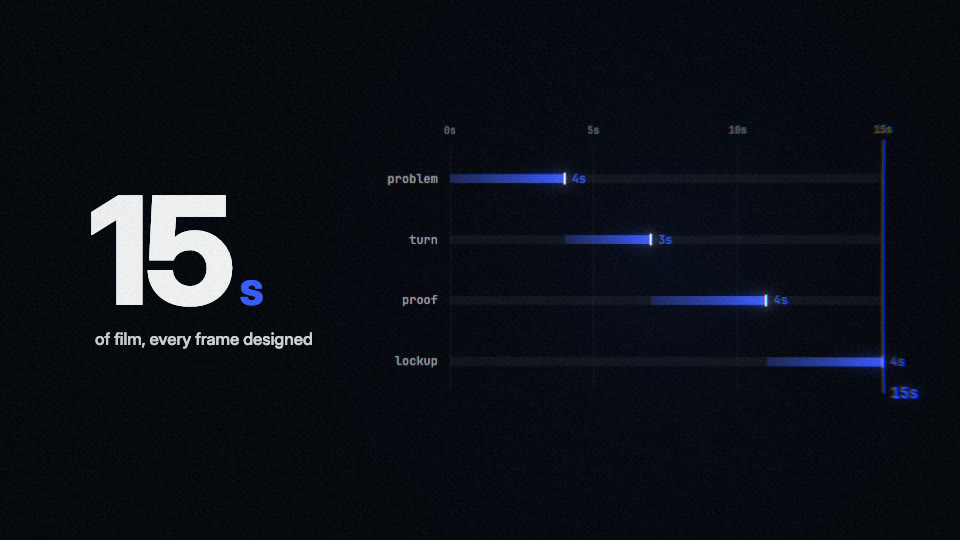
Try the following allocation on paper. The timings are an editing proposal; adjust them after reading the text at its final size.
| Time | Job of the scene | What to decide |
|---|---|---|
| 0–3 seconds | Establish the situation | One recognizable tension or question |
| 3–7 seconds | Reveal the brand’s approach | The action or mechanism that changes things |
| 7–11 seconds | Make the claim believable | One visible piece of evidence |
| 11–15 seconds | Leave a clear ending | Brand, takeaway and one next step |
Use three columns in your own storyboard: what we see, what we read, what we hear. If all three introduce different information at once, simplify the scene. A sound accent can underline the arrival of the evidence; it does not need another line of copy to explain it.
Give the ending enough room
A logo appearing on the last frame is easy to miss. Reserve a readable hold for the brand and the final thought. The appropriate hold depends on the amount of text, language and viewing size; check it with the actual render rather than a word-count formula.
Choose one next step. “See the demo” and “Book a conversation” ask for different levels of commitment. Match the ending to the page or placement the viewer can actually reach. For a social placement without a clickable video, make the surrounding post carry the link.
Review it once with sound, once without
Play the draft at normal speed without pausing. Then watch it on a small screen with the sound off. Ask a person who has not read the brief to tell you what the brand does and which detail made the claim believable.
If they remember a transition but cannot explain the point, revisit the script. If they understand the point but cannot read the evidence, simplify the frame or extend the hold. Add visual polish after those two problems are solved.
Before handing the script to a director, make sure you have:
- One sentence describing the claim.
- One source-backed piece of evidence.
- A four-beat storyboard with readable copy.
- One ending with a real destination.
- A list of statements that still need confirmation.
For the source material behind that handoff, use our website-to-video preparation checklist. You can also explore PulseMotion’s live demos. Website-to-film generation is in early access and is not yet open to the public.