PulseMotion
Kumo-cha is a fictional brand created for a PulseMotion demo. Its name, history and production claims belong to the sample brief. This is a record of creative decisions, not a customer case study or evidence about tea production.
The brief contained several possible stories: a founding year, farms, shaded cultivation and stone mills. We chose the mill. The central detail was small enough to understand and specific enough to draw: one mill, one hour, 40 grams.
The film’s question became: how do you make slowness visible in fifteen seconds?
Let one fact choose the visual idea
The selected concept was “One hour, in circles.” A rotating machine, a millstone, a clock, a tea bowl and the ring in the logo could share a shape while changing meaning. That gave the film a visual connection from the first shot to the last.
The important contrast was speed. The opening machine moves quickly; the cut to the stone makes the motion settle. The viewer encounters the difference before the large number appears.
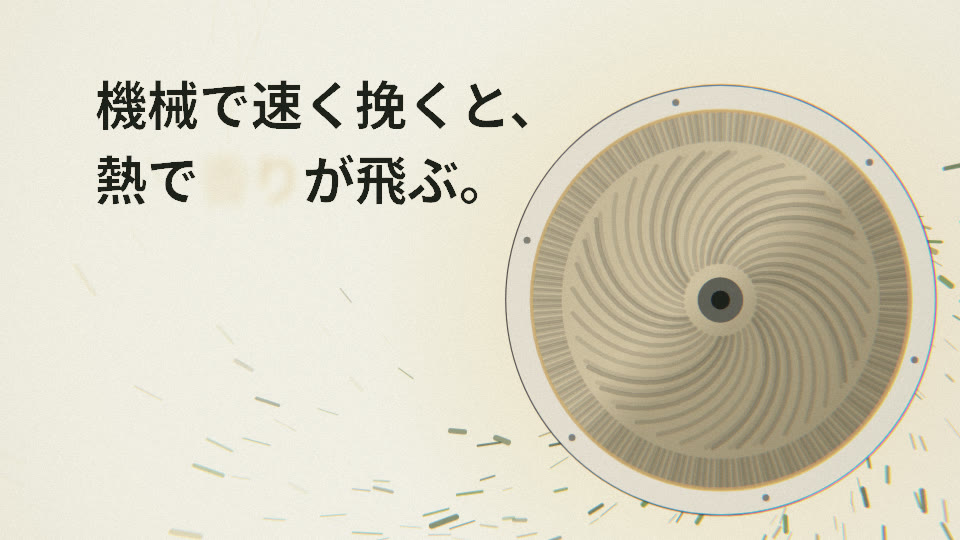
Two other concepts were considered. “Where the aroma goes” made the Japanese characters for aroma the main event. It expressed loss, but left the mill and the 40 grams mostly as words. Part of it survived as an accent in the opening.
“A cloud at dawn” followed tea fields and green powder into the cloud of the logo. It shifted attention toward the farm story, and the proposed dark glow conflicted with the brief’s light, paper-like identity. We did not use it as the film’s direction.
Give each scene a different job
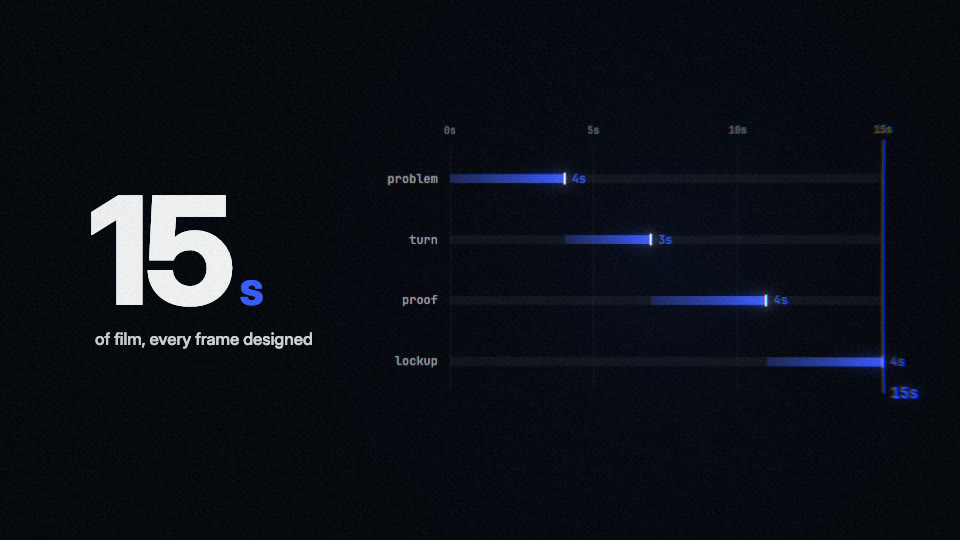
The film uses 28 beats at 112 BPM: exactly 15 seconds. The scene boundaries below are rounded to two decimal places from that beat structure.
| Time | Scene | Narrative job |
|---|---|---|
| 0–2.14 s | Fast machine | Introduce the brief’s tension around speed |
| 2.14–5.36 s | Slow stone mill | Show the brand’s chosen process |
| 5.36–9.11 s | The hour and 40 grams | Make the scale of slowness visible |
| 9.11–12.32 s | Foam and tea bowl | Move from process to the intended drinking experience |
| 12.32–15 s | Bowl becoming the mark | Resolve the story into the brand |
The shape does not have to move at the same speed just because the music has a steady tempo. The opening is busy; the mill is calm; the hour builds; the ending holds. This contrast is what gives the cut to the stone its weight.
Make the number mean something
“40” on its own could be a price, a score or a percentage. The surrounding words preserve the unit and scope: grams, per mill, per hour. The sweeping time cue and accumulating powder connect that statement to a visible process.
The number comes from the fictional brief. We did not add a temperature for the machine, a measured aroma-loss percentage or a particle-size claim. Those would require evidence the brief did not contain.
We also kept a proposed “one can in thirty minutes” line out of the film because the brief did not specify the can size in a corresponding fact. A more vivid sentence is not automatically a better-supported one.
Keep the finish inside the brand’s world
The visual palette follows the sample’s paper background, matcha green, dark ink and restrained gold accent. The gold carries heat and time; green carries tea. The colour choices give recurring elements a stable role.
The final transition uses the bowl’s rim to reach the logo’s ring. It avoids introducing a new visual trick at the moment the brand should become clear.

The production review also recorded practical repairs: the mark needed a smoother outline, fine foam needed to remain crisp, and impact movement needed enough background beyond the visible frame. These were corrections to the image, not new claims about the brand.
Take the method, then find your own images
The transferable part is the sequence of decisions: choose one supported detail, find a visual form inside the brand, assign each scene a job and remove statements that lack evidence. Another brand may need an entirely different shape, pace and palette.
This write-up is based on the demo’s original brief, final scene timing and production review. The frames are from that film. It does not report customer results, campaign performance or an independent creative score.
Watch the Kumo-cha demo in our work section, then use the 15-second script guide to outline a story from your own material.